Differentiable Forward Modelling for Radio
Towards Cosmology with SKA








ARray for Gigahertz ObservationS: a European initiative for a low-cost, sustainable radio interferometer in Crete 🇬🇷
- Modular, scalable and affordable design
- Pathfinder: 5 × 6 m dishes installed at FORTH
- Full planned array: ~1000 antennas, 1–3 GHz, baselines up to ~4 km
- Science: FRBs (strongly lensed FRBs → ~1% \(H_0\)), pulsars, GWs, radio transients
- Designing the array and its imaging software calls for fast, flexible simulations
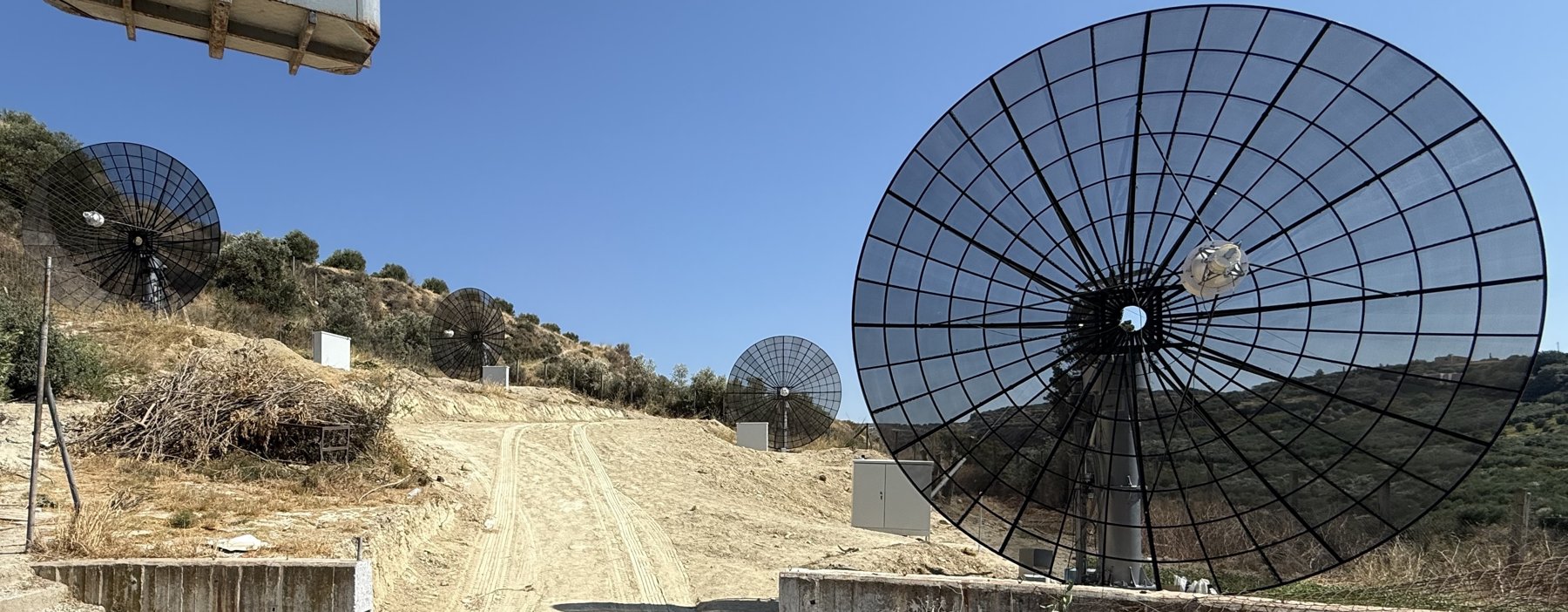
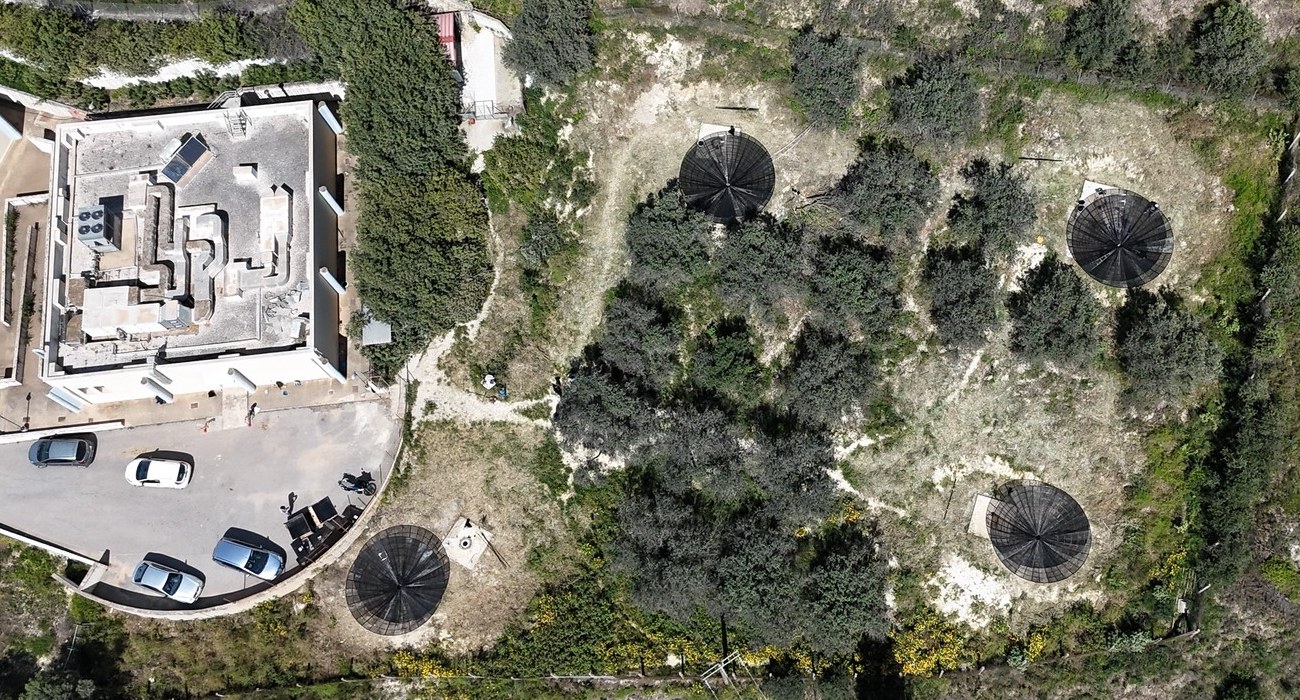
ARGOS Pathfinder at FORTH: ground and aerial views
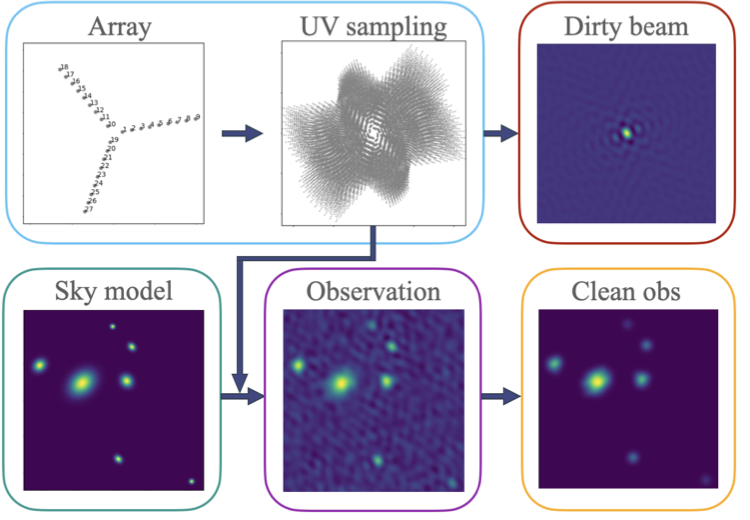
argosim simulation pipeline: from antenna layout to CLEAN image
Centofanti et al. (2026a) • arXiv:2606.25573
github.com/ARGOS-telescope/argosim
- Lightweight, modular Python package for radio simulations
- Full chain: array → uv tracks → visibilities → dirty beam & image → CLEAN, plus PSF/image metrics
- JAX backend: ~40× faster than NumPy on CPU, up to ~800× on GPU
- End-to-end differentiable → gradients
- Open source, Docker image and GUI
pip install argosim
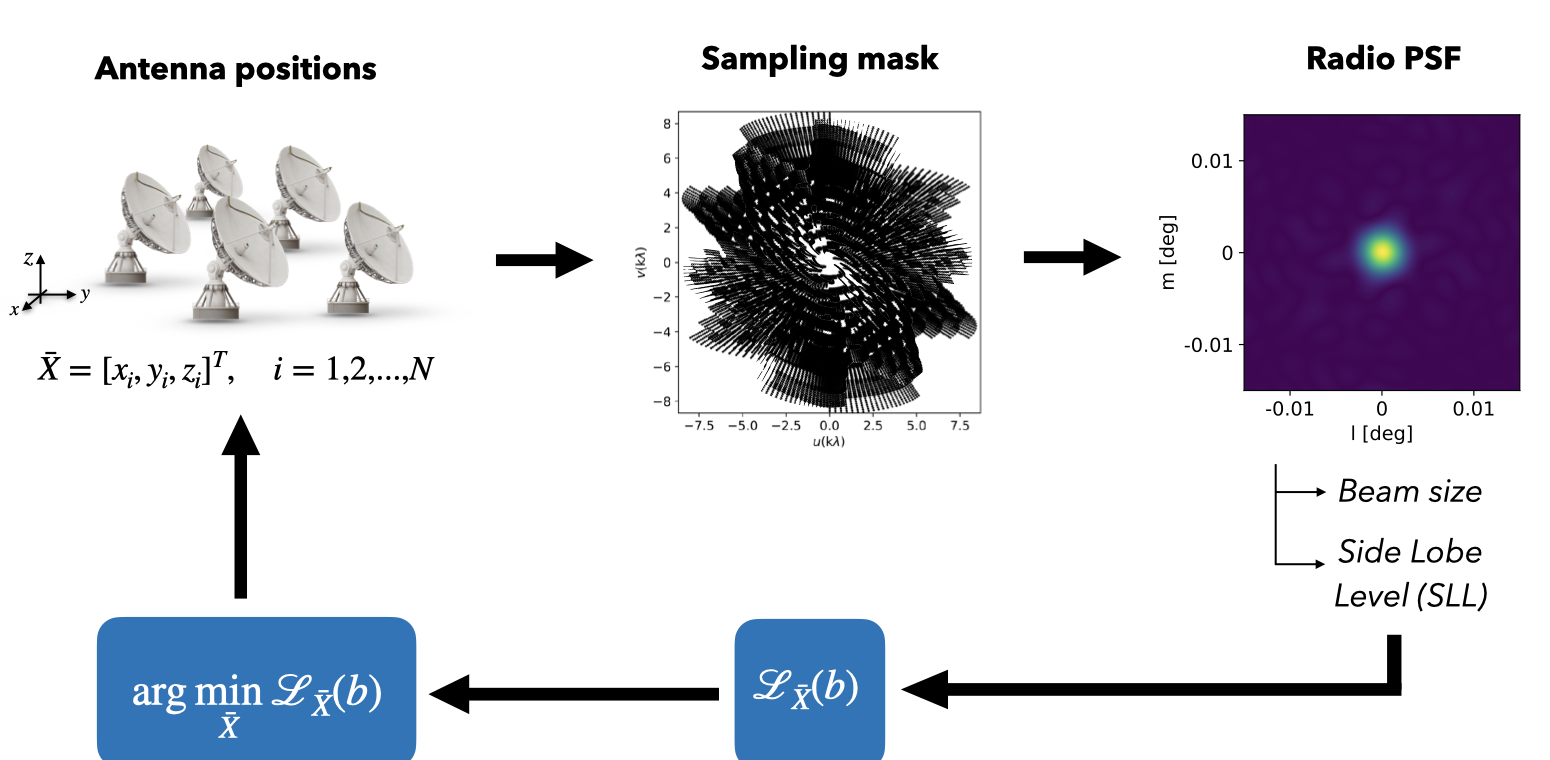
- Proof of concept: Can we optimise the position of antennas in an array for a given science case?
- Compare the PSF \(b(X)\) synthesised by argosim from antenna positions \(X\) to a given target PSF \(b_{\rm tg}\): e.g. a Gaussian PSF
- Physical constraints: minimum antenna separation (\(g_D\)), available area (\(g_R\)), array centring (\(g_C\))
- Any differentiable loss works, e.g. sidelobe level or FWHM directly
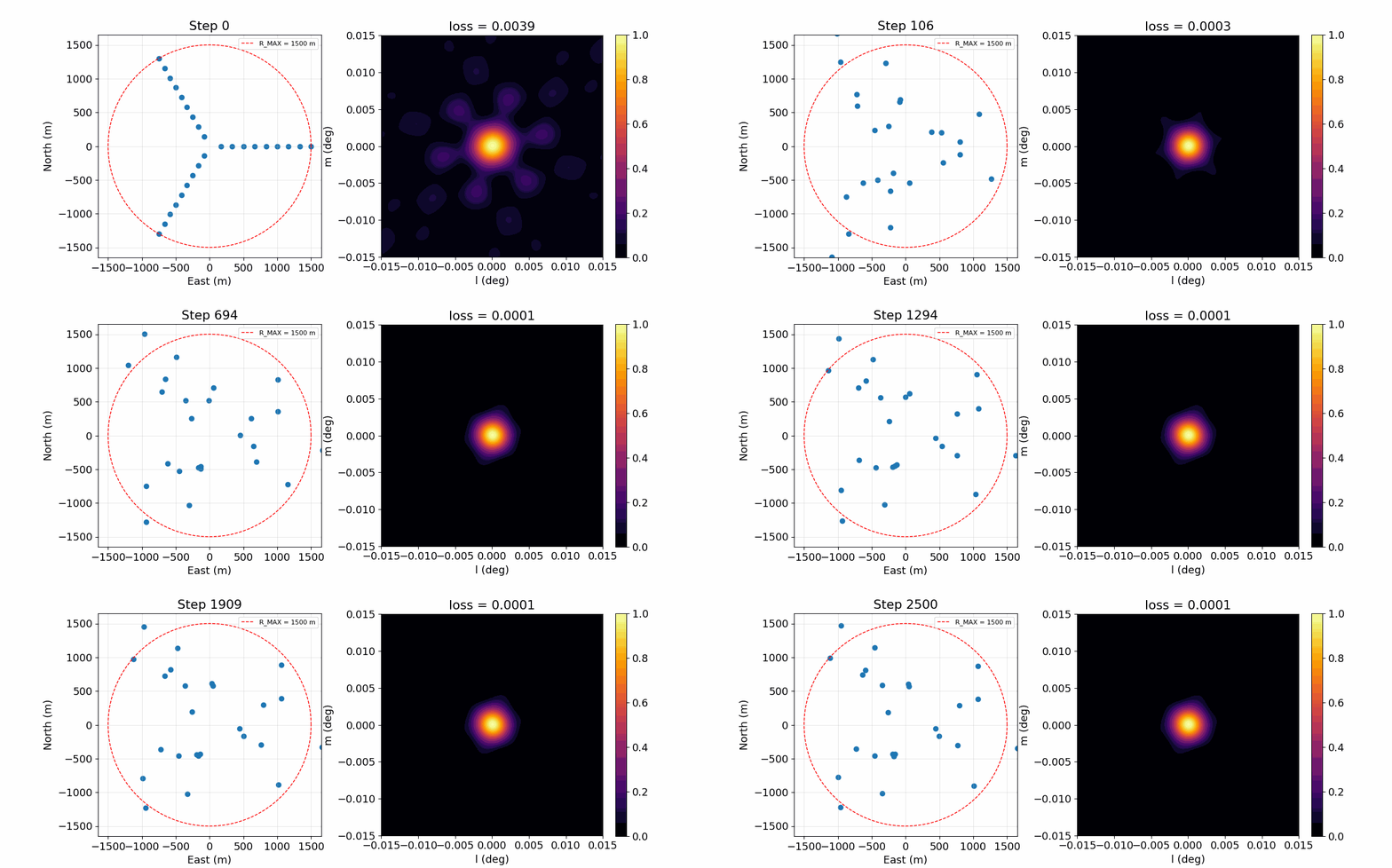
27 antennas starting from a Y-array (1.5 km radius) · lat 35°, dec 32° · 2 GHz, 1 h track · Adam optimiser, ~30 s on CPU. Centofanti et al. (2026a)
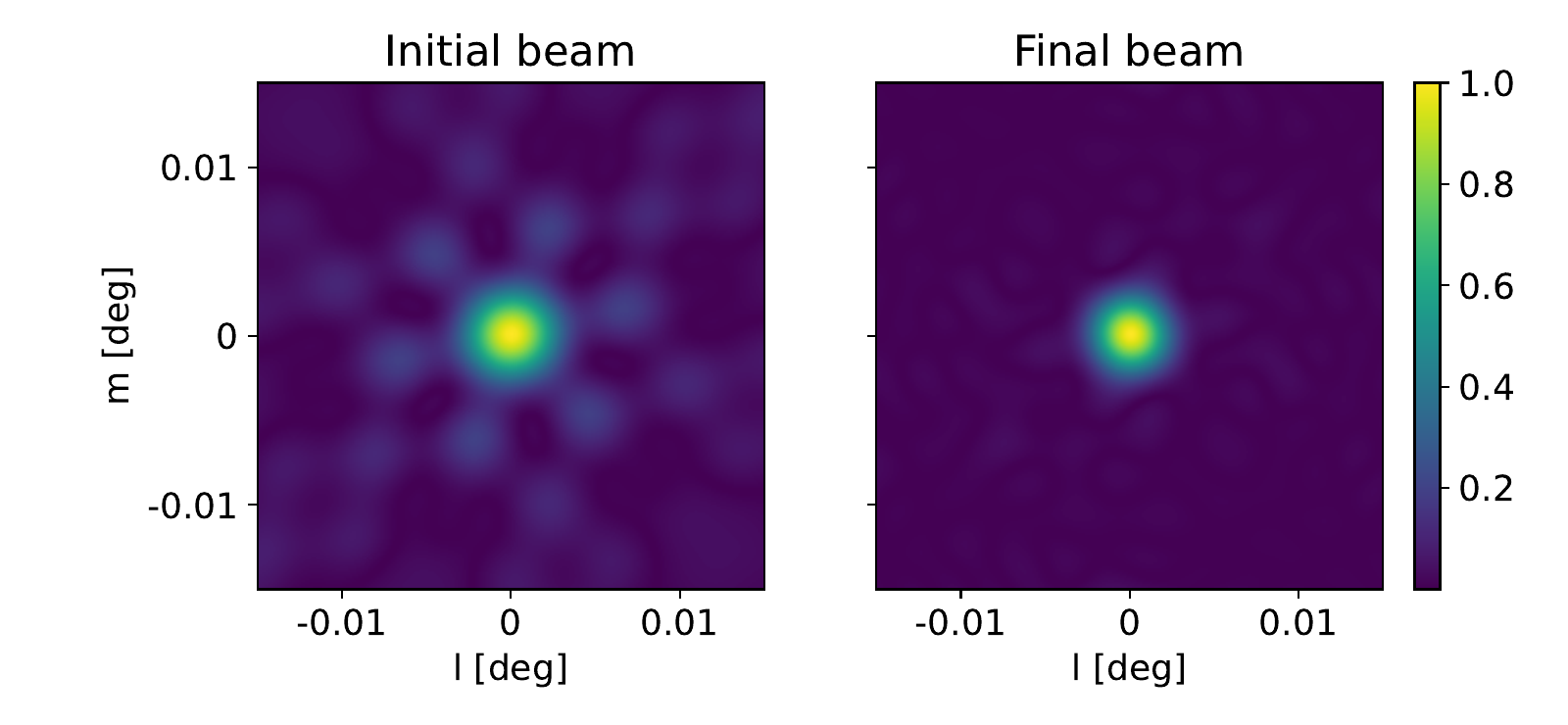
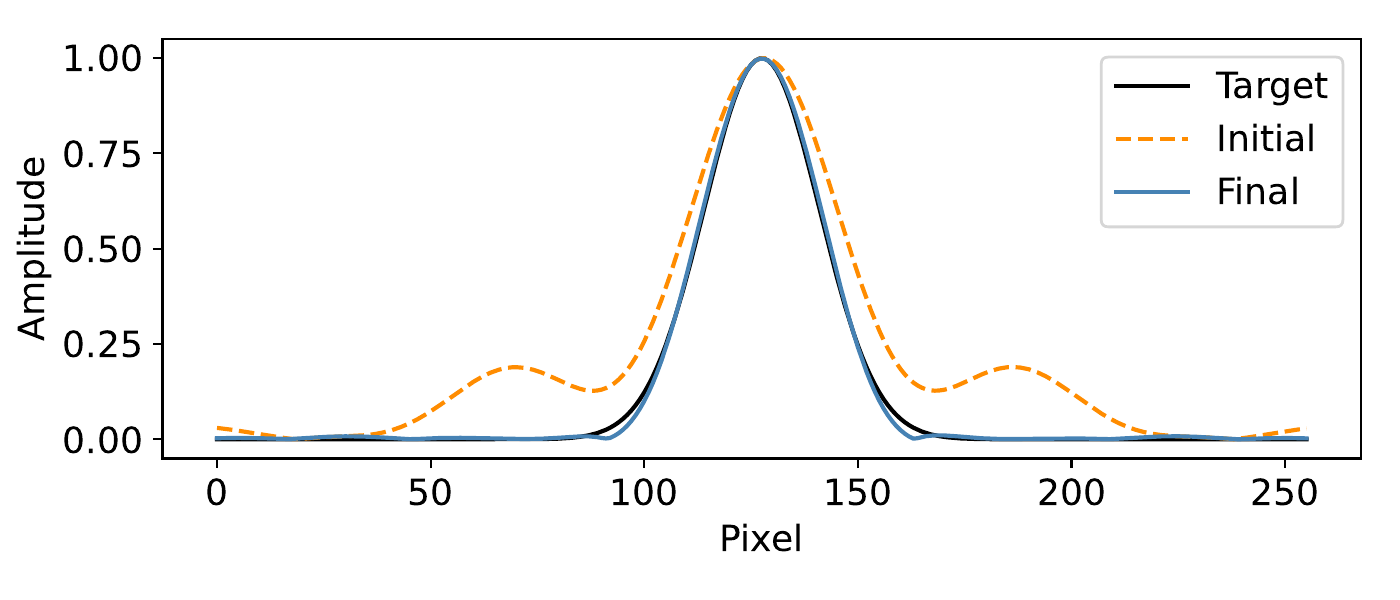
| ISL [dB] | PSL [dB] | FWHM [px] | e | |
|---|---|---|---|---|
| Initial | −6.3 | −14.2 | (40, 38) | 0.32 |
| Final | −19.7 | −27.5 | (32, 32) | 0.16 |
- Main lobe matches the target; sidelobes suppressed by ~13 dB
- Optimum for one observing setup → next: multiple declinations, frequencies and track lengths in a single loss
A powerful cosmological probe
- Traces all matter, dark and baryonic
- Sensitive to both geometry and the growth of structure: constrains \(\Omega_m\), \(S_8\) and dark energy
- KiDS, DES, HSC → Euclid, Rubin, Roman, SKA
A tiny statistical signal
\[\epsilon^{\rm obs} \approx \epsilon^{\rm int} + \gamma \quad \Rightarrow \quad \langle \epsilon^{\rm obs} \rangle \approx \gamma\]- \(\lvert\gamma\rvert \sim 0.01 \ll \sigma_\epsilon \sim 0.2\) → many precise shapes
What we must control
\[\hat{\gamma}_i = (1 + m_i)\,\gamma_i + c_i\]- Multiplicative \(m\) and additive \(c\) biases must vanish
- Any residual biases the cosmology
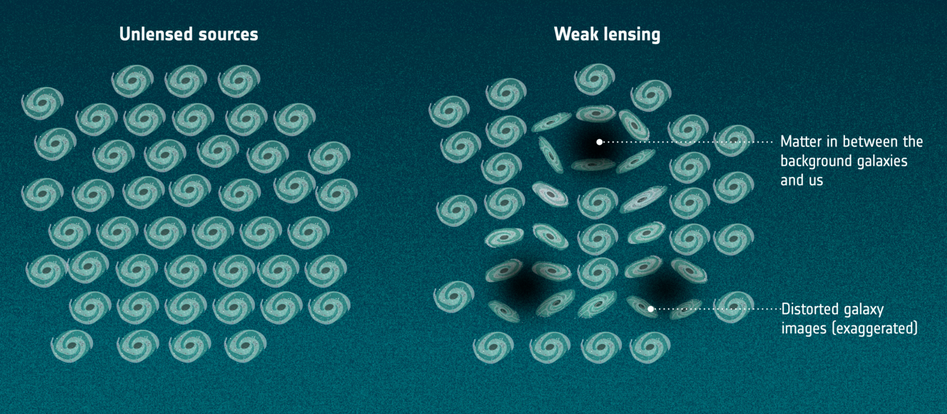
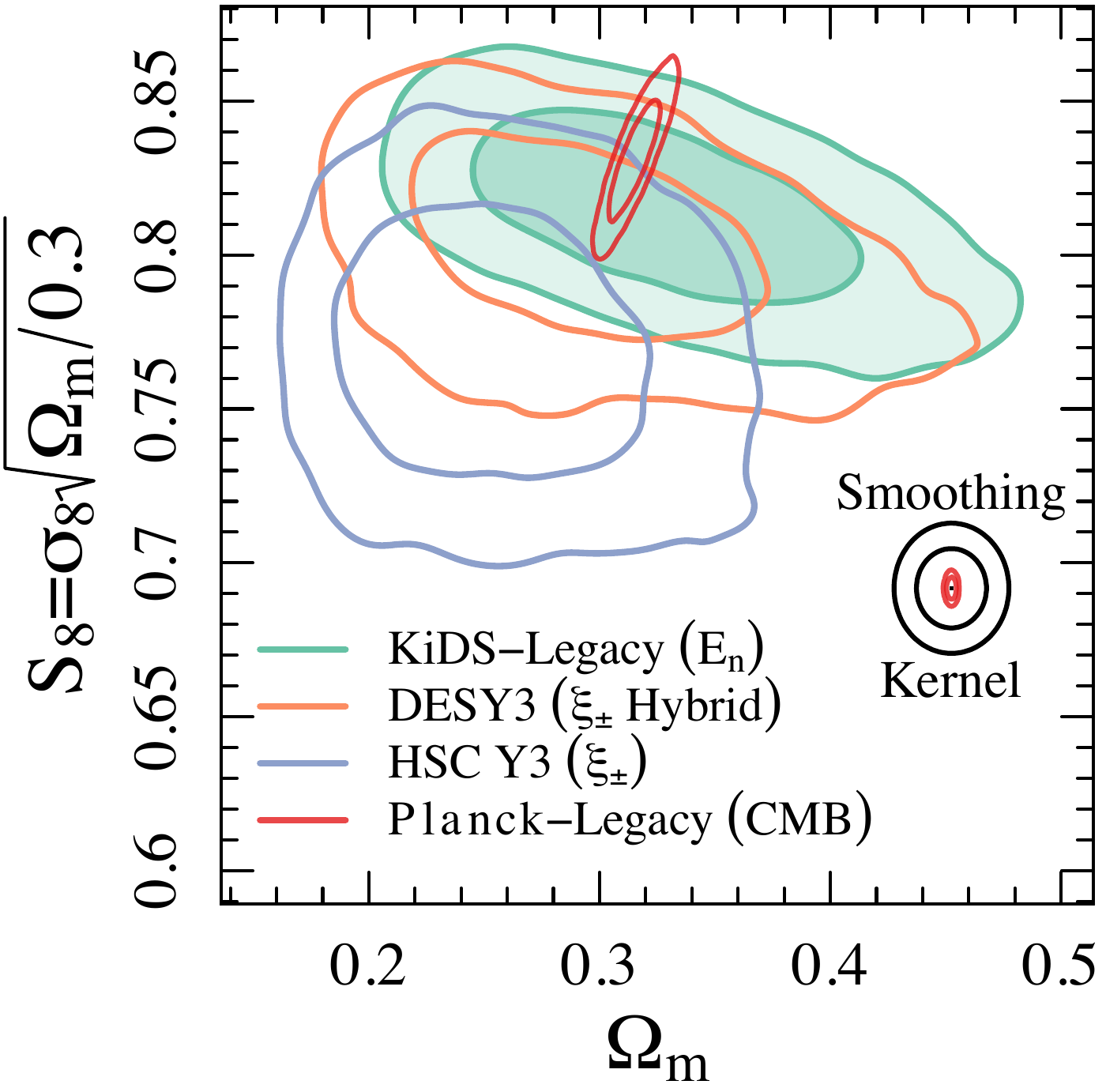
Top: lensing by large-scale structure (ESA). Bottom: cosmic-shear constraints vs Planck CMB (Wright et al. 2025)
Opportunities
- AA4: 5 000 deg², ~50 M galaxies, \(z_m \sim 1.1\)
- \(S_8\) to 5% alone, 3% with Euclid or LSST
- With clustering and HI: ~1% on ΛCDM parameters
- Different systematics → robustness test
- Polarisation and kinematics separate lensing from intrinsic shapes
Challenges
- Data are visibilities: galaxies are delocalised in Fourier space
- Deconvolution artefacts → biased shapes
- Ellipticity is ill-defined for complex morphologies → model bias
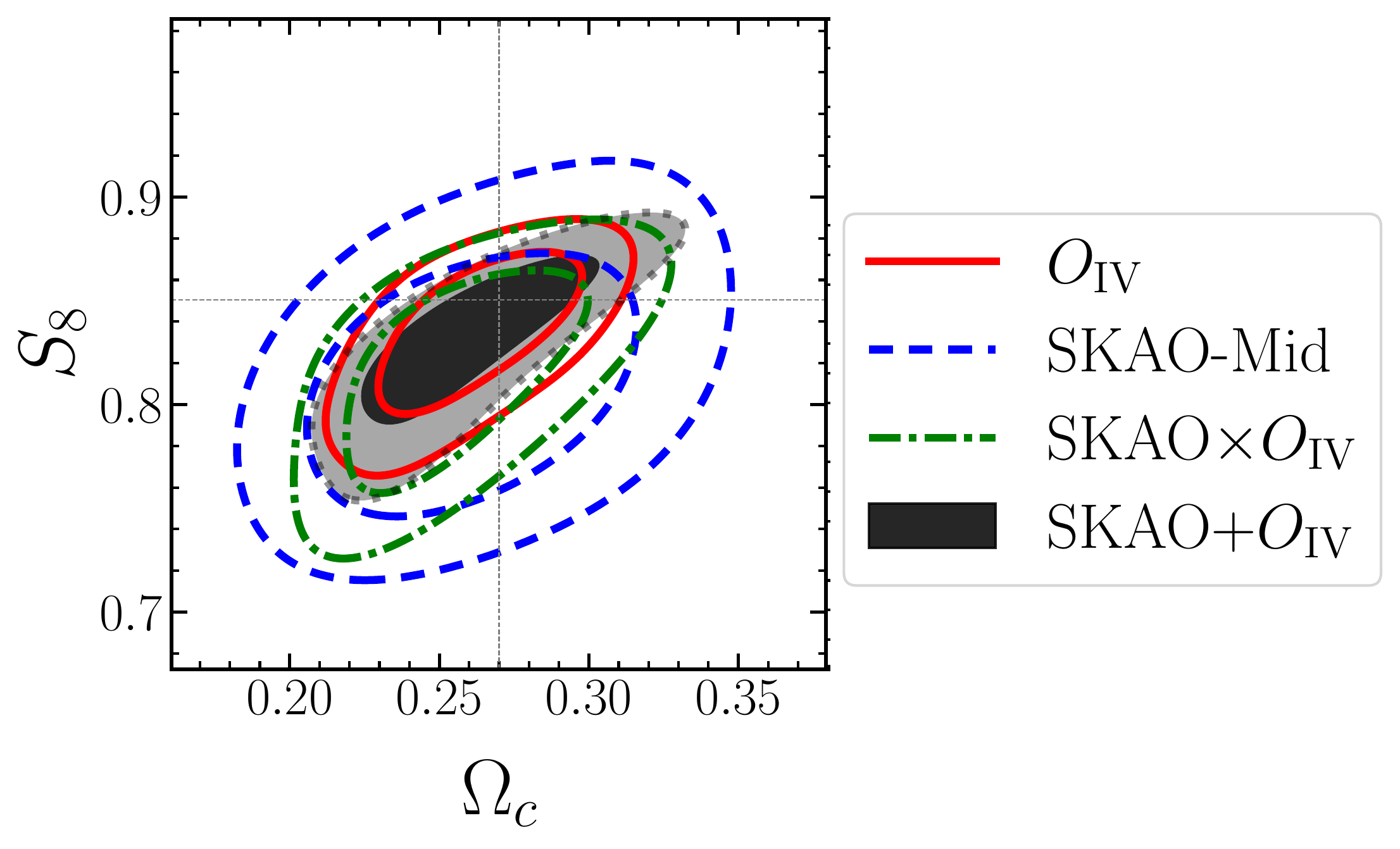
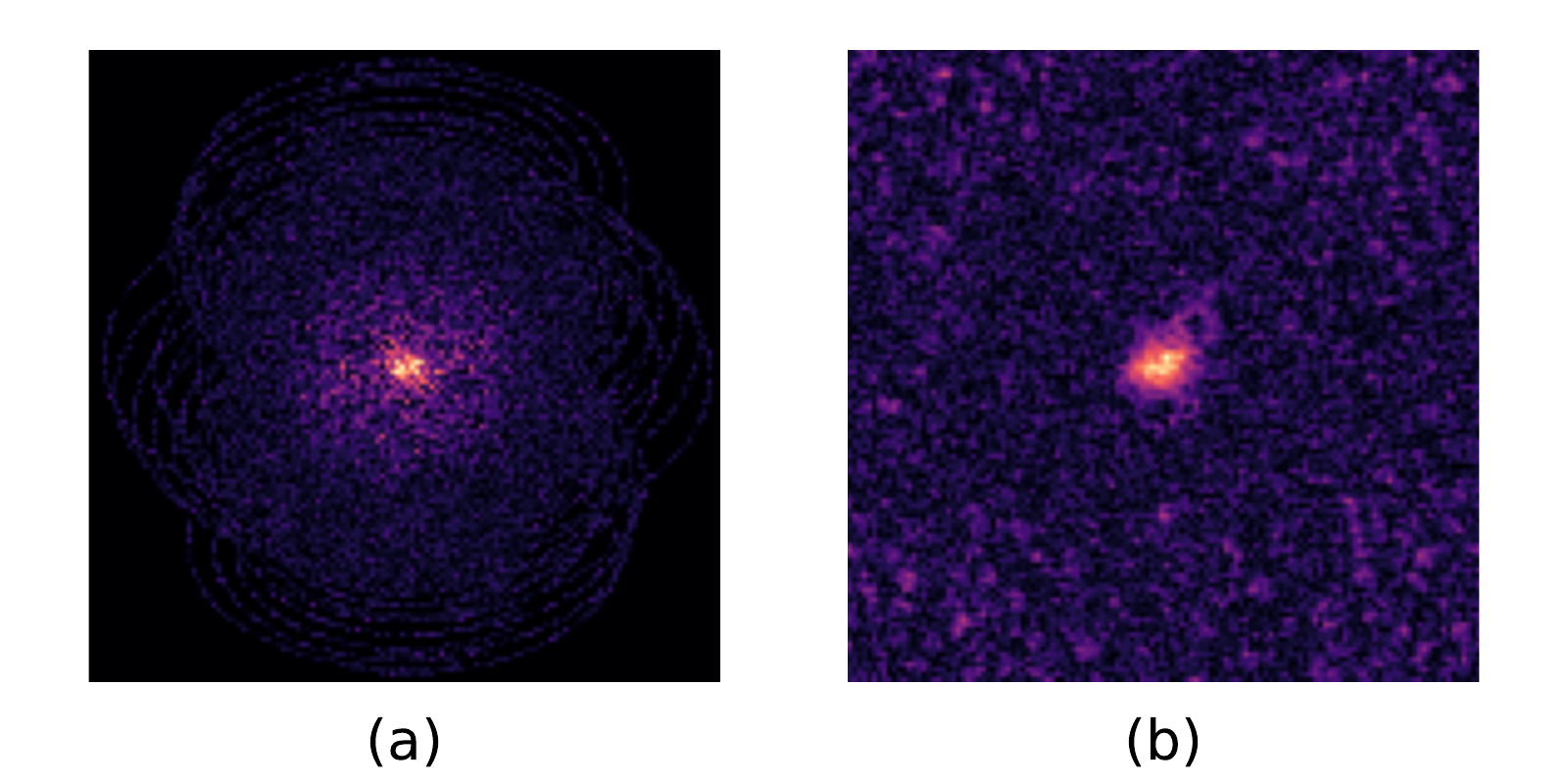
Top: forecast constraints (after Harrison et al. 2026). Bottom: radio-adapted COSMOS galaxy (Centofanti et al. 2026b)
SHINE: forward-modelling framework for probabilistic shear inference
Centofanti et al. (2026b) • Coming soon to arXiv!
github.com/CosmoStat/SHINE
- Forward-modelling framework for probabilistic shear estimation
- No shape measurement: model the data directly, not galaxy ellipticities
- JAX-powered: autodiff and GPU acceleration (JAX-GalSim, BlackJAX)
- Versatile: designed for both optical and radio surveys
- Radio forward model built on argosim
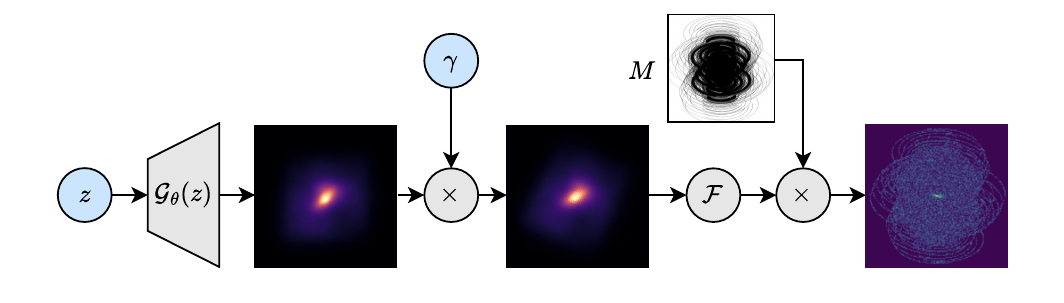
- \(\mathcal{G}_\theta(z)\): galaxy generator (simulates galaxy images)
- Shear \(\gamma\) applied at pixel level with JAX-GalSim
- uv mask \(M\) from argosim: SKA-Mid, 8 h track, 1.4 GHz
- Gaussian likelihood directly in visibility space: no imaging, no deconvolution, no shape measurement
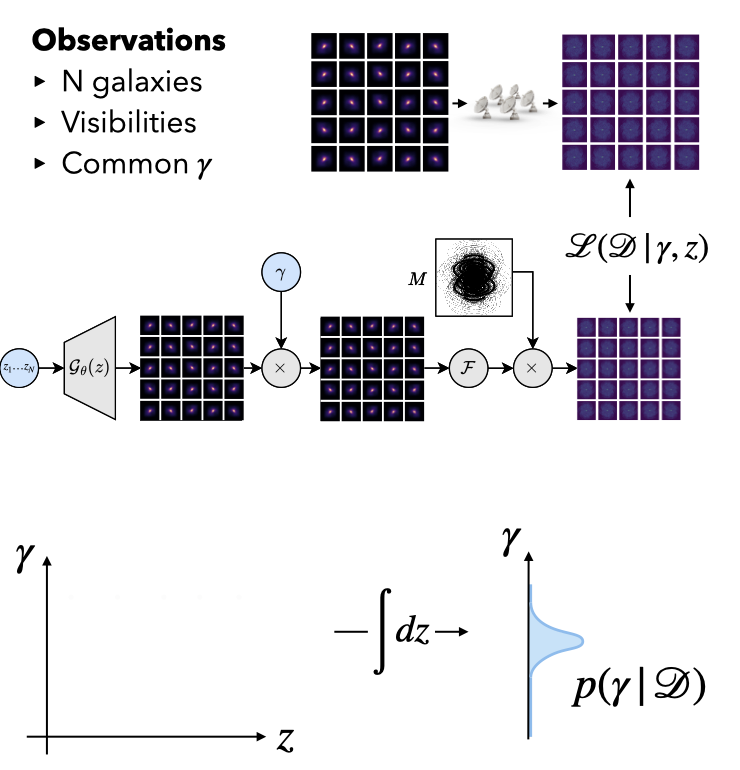
- Hierarchical model: galaxies in a patch share one \(\gamma\); morphology parameters \(z_i\) are marginalised
- 100 galaxies per batch → >700 parameters → gradient-based MCLMC sampling
- Posterior per batch fitted with a GMM, then batches combined analytically
- ~60 ms per galaxy on V100 GPUs (parametric model)
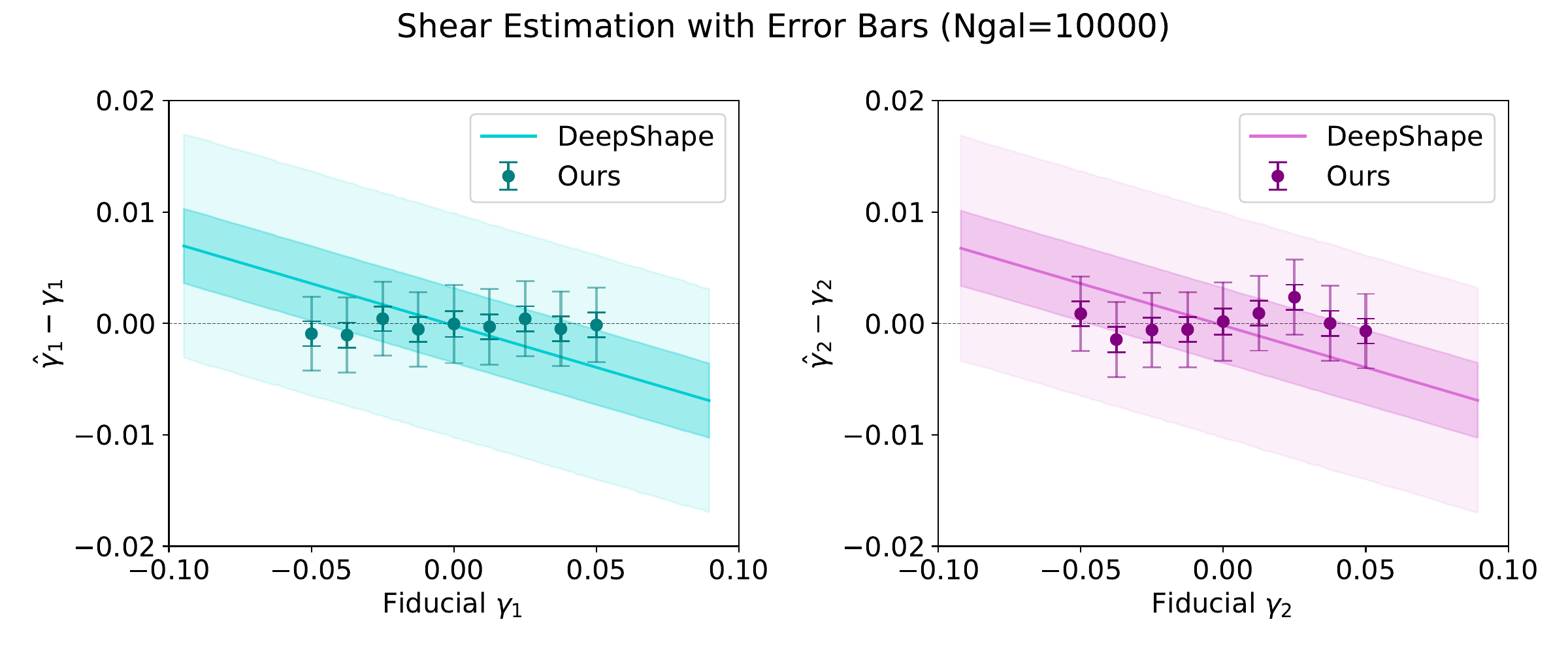
- 10 000 T-RECS-like galaxies (Spergel profiles), SKA-Mid, S/N 10–80
- ~3× smaller uncertainty than DeepShape (Tripathi et al. 2025), with no apparent multiplicative bias
- Coverage test (125 posteriors): uncertainties are well calibrated
- Training data: 80 000 HST COSMOS galaxies (no well-resolved radio sample exists)
- Architecture: Deep Compression AE (ResNet blocks), 128×128 image → 4×4 latent \(z\)
- Loss: the HST PSF is applied to the decoder output, so the AE learns the unconvolved profile
- Prior: Real NVP normalising flow, \(z = f(u)\) with \(u \sim \mathcal{N}(0, I)\)
- Speed: distilled decoder (18 M → 0.8 M parameters, float16), ~10× faster
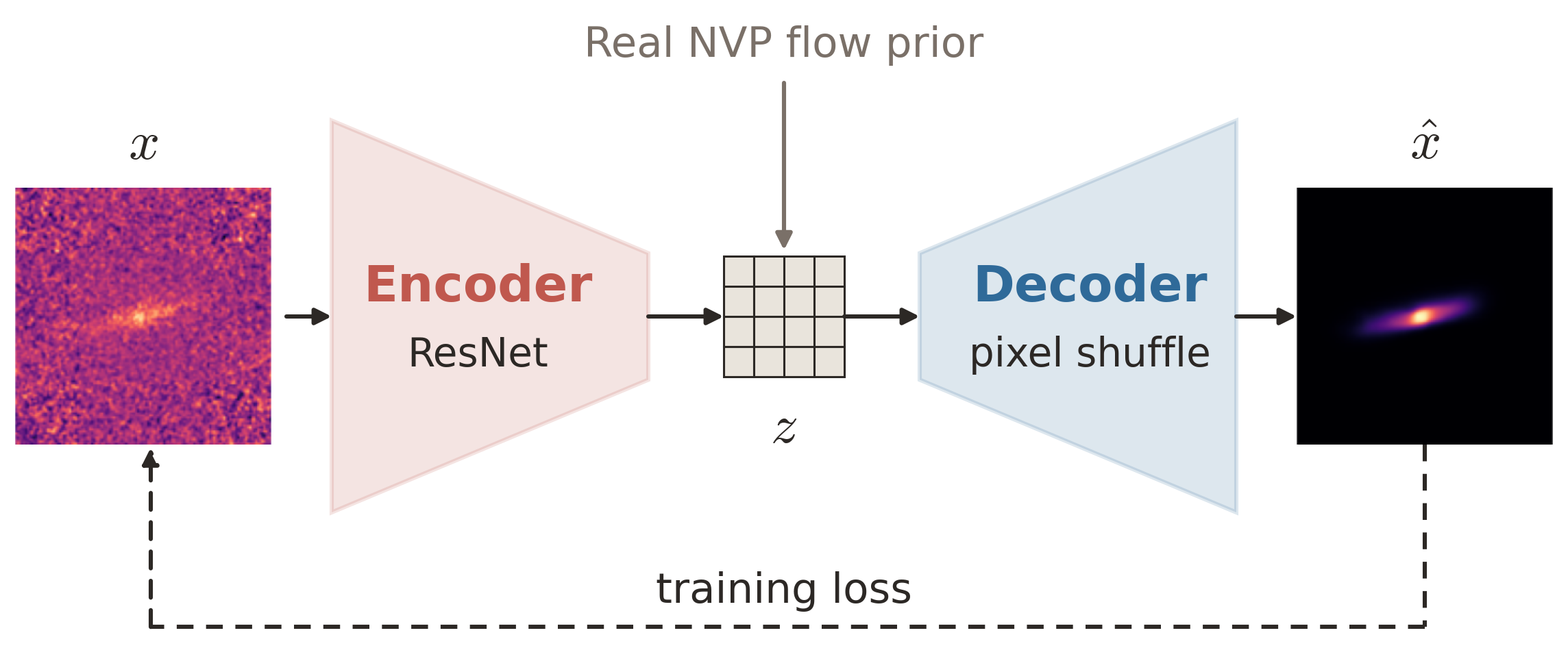
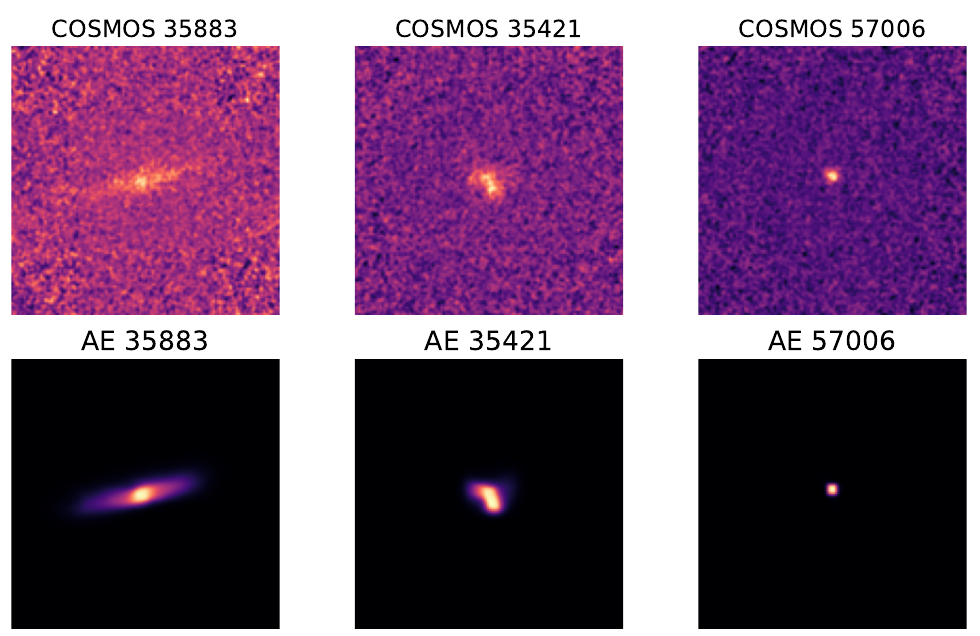
Top: AE architecture. Bottom: COSMOS galaxies and their unconvolved AE reconstructions (Centofanti et al. 2026b)
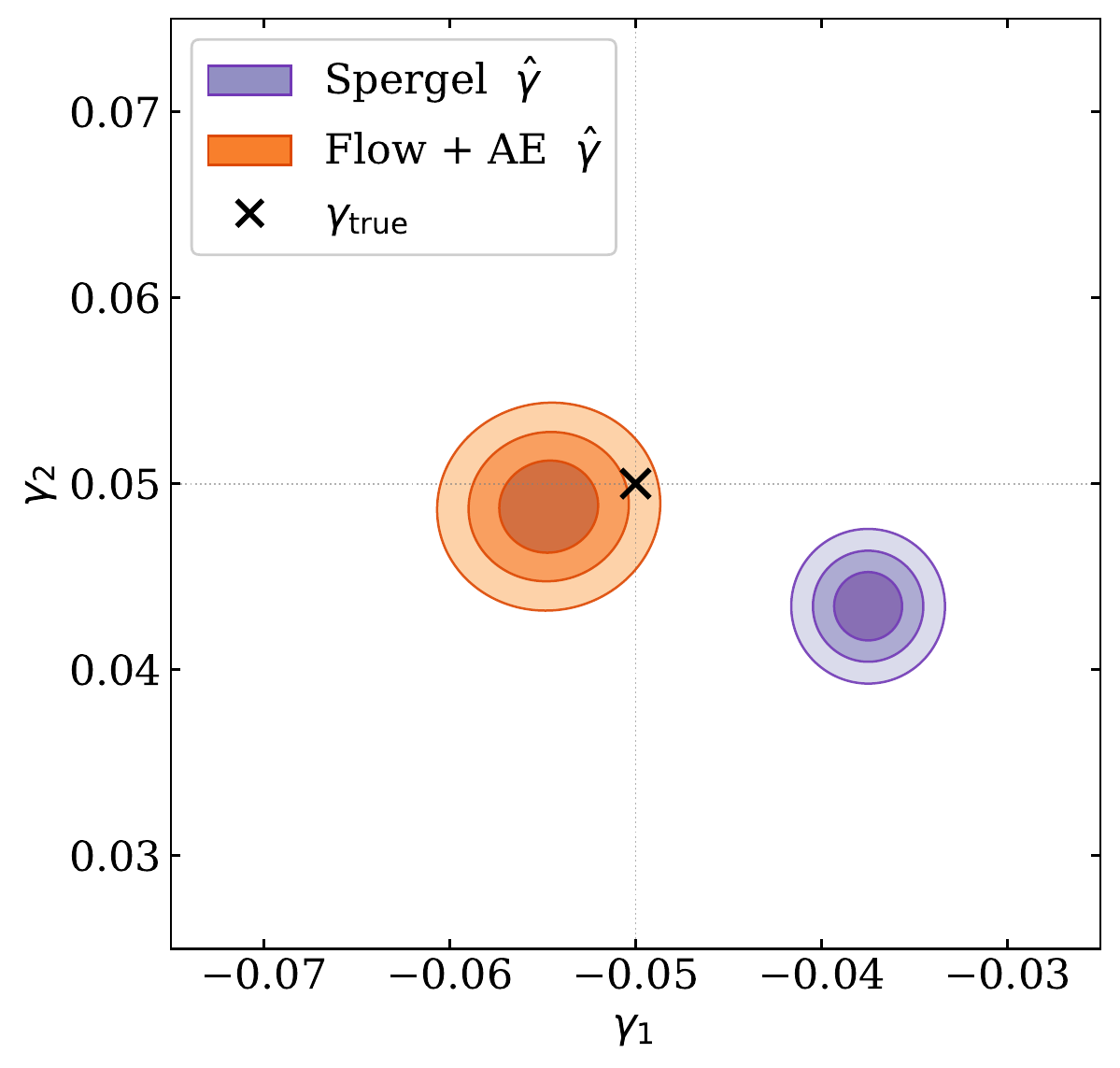
10 000 HST COSMOS galaxies adapted to radio, with \(\gamma_{\rm true} = (-0.05, 0.05)\)
- Spergel model: morphology mismatch → bias > 10σ
- AE generative model with flow prior on the latent space: bias reduced to < 2σ
- MAP point estimate: up to 30× faster and consistent with the posterior, but without uncertainty